Top 10 Plastic Fabrication Companies: Why JaiRaj Group Tops the List

Top 10 Plastic Fabrication Companies: Why JaiRaj Group Tops the List
Table of Contents

Your assembly line stops because a plastic component fails. The fabrication supplier lacks the process depth to deliver consistent quality. You face expediting costs, requalification delays, and program management escalations.

Finding a reliable plastic fabrication company is not simple. Vendors offer CNC machining but lack moulding. Others provide welding, but cannot assemble. You need a partner with breadth and depth across fabrication disciplines.

This guide profiles ten leading plastic fabrication companies serving India and the USA. You will learn their core expertise and ideal project fit. You will also understand why JaiRaj Group ranks first for complex, multi-process programs.

An Overview

  • Plastic fabrication encompasses cutting, welding, forming, moulding, and assembly of polymer components.
  • JaiRaj Group offers the broadest process range: injection, blow, rotational, extrusion, welding, and machining.
  • US-based fabricators excel in CNC machining and sheet fabrication for low-to-medium volumes.
  • Indian fabricators provide cost-competitive moulding and tooling for high-volume production.
  • Multi-process capability reduces your supply chain complexity and qualification risk.
  • Certifications like IATF 16949 and ISO 14001 are non-negotiable for automotive and defence sourcing.

Top 10 Plastic Fabrication Companies for Your Next Industrial Project

You need a partner who combines fabrication capability, engineering depth, compliance systems, and supply stability across India and the USA.

The following companies represent established plastic fabrication providers serving automotive, aerospace, industrial, appliance, and defense markets.

Below are the companies and their core strengths:

1. JaiRaj Group
JaiRaj Group

Overview:
JaiRaj Group is an Indian plastic fabrication and precision components manufacturer with more than 35 years of experience serving automotive, EV, heavy equipment, aerospace, defense, and industrial programs.

Expertise:

  • Injection moulding, blow moulding, rotational moulding, extrusion, welding, and tooling.
  • Multi-location manufacturing footprint across Faridabad, Rudrapur, Aurangabad, Manesar, and Sanand.
  • Certified systems, including ISO and IATF-aligned processes.

You can explore their capabilities through Plastic Bellows & Struts, Brake & Accelerator Pedal, Shockers & Suspension Components, Braking System Components, and Hand Grips.
Advanced sectors are supported through Precision Components From Advance Polymers and Solar Plastic Components.

Best for: OEMs and Tier-1 suppliers require integrated fabrication, moulding, and assembly with compliance discipline.

Why JaiRaj Group stands out:

When you evaluate plastic fabrication companies, you should look beyond equipment lists and focus on execution control across the product lifecycle. JaiRaj Group differentiates itself through integrated governance, engineering depth, and supply continuity across regulated industries.

Key differentiators include:

  • Integrated multi-process capability covering injection moulding, blow moulding, rotational moulding, extrusion, and fabrication under one coordinated framework.
  • In-house tooling and mould development, reducing revision cycles and improving dimensional consistency during ramp-up.
  • Automotive-grade quality systems, including IATF-aligned processes that support PPAP, APQP, and structured validation workflows.
  • Multi-location manufacturing footprint across Faridabad, Rudrapur, Aurangabad, Manesar, and Sanand, strengthening supply resilience.
  • Cross-industry program experience spanning automotive, EV, heavy equipment, aerospace, defense, and industrial applications.

This integrated approach supports programs ranging from Braking System Components to Earth Movers and Heavy Vehicle Components, where tooling governance, compliance discipline, and lifecycle stability directly affect program performance.

2. Emco Industrial Plastics, Inc.

Overview:
Emco Industrial Plastics is a US-based plastic fabrication company specializing in CNC machining, forming, plastic welding, and precision cutting for industrial sectors.

Expertise:

  • CNC machining of industrial thermoplastics.
  • Plastic welding and custom forming.
  • Component assembly and finishing services.

Best for: US industrial applications requiring machining-driven fabrication services.

3. Iten Industries

Overview:
Iten Industries is a US plastic fabrication company offering machining, custom fabrication, and prototyping services for industrial and transportation markets.

Expertise:

  • Precision machining of engineering plastics.
  • Custom component fabrication.
  • Prototype-to-production support.

Best for: US programs requiring engineered machined plastic components.

4. Lehigh Valley Plastics, Inc.

Overview:
Lehigh Valley Plastics provides custom plastic fabrication solutions for industrial and commercial sectors across the United States.

Expertise:

  • Fabricated plastic panels and components.
  • CNC routing and machining.
  • Assembly support.

Best for: Mid-volume industrial fabrication requirements.

5. New Process Fibre, Inc.

Overview:
New Process Fibre manufactures precision plastic components for the automotive, aerospace, and electronics industries in the United States.

Expertise:

  • Precision-fabricated components.
  • Injection moulding integration.
  • Engineering plastics expertise.

Best for: US automotive and aerospace plastic components.

Also read: Blow Molding vs Rotational Molding: Key Differences Explained
6. Total Plastics, Inc.

Overview:
Total Plastics distributes and fabricates plastic products for aerospace, automotive, medical, and industrial customers.

Expertise:

  • Plastic sheet fabrication.
  • Industrial plastic distribution.
  • Machining and finishing services.

Best for: North American sheet-based fabrication needs.

7. UNIPEC, Inc.

Overview:
UNIPEC manufactures custom plastic components serving automotive, aerospace, and industrial markets in the United States.

Expertise:

  • Custom plastic fabrication.
  • Engineering plastic solutions.
  • Industrial component production.

Best for: US OEMs seeking engineered plastic components.

8. Dalal Plastics Pvt. Ltd.

Overview:
Dalal Plastics is an Indian plastic moulding and fabrication company serving automotive, electrical, and industrial sectors.

Expertise:

  • Injection moulding.
  • Tooling and mould development.
  • Precision plastic components.

Best for: Indian OEMs that require moulding-led fabrication support.

9. PolyeRubb Industries

Overview:
PolyeRubb Industries is an Ahmedabad-based manufacturer producing molded plastics, rubber components, and extruded industrial products.

Expertise:

  • Plastic and rubber moulded components.
  • Industrial fabrication services.
  • Extruded product manufacturing.

Best for: Indian industrial component supply.

10. Leister Technologies India Pvt. Ltd.

Overview:
Leister Technologies India supplies plastic welding equipment and supports fabrication requirements in industrial sectors.

Expertise:

  • Plastic welding systems.
  • Fabrication support solutions.
  • Industrial thermal processing equipment.

Best for: Indian industrial plastic welding applications.

Even with a structured evaluation framework in place, supplier selection can still go wrong if critical risks are overlooked.

Understanding where procurement teams typically make errors will help you pressure-test your decision before finalizing a plastic fabrication company.

Also read: PP vs PVC: Understanding Performance and Application Differences

How to Choose the Right Plastic Fabrication Company

A systematic selection process prevents mismatched capabilities and program delays. Your evaluation must align supplier strengths with your component requirements.

How to Choose the Right Plastic Fabrication Company

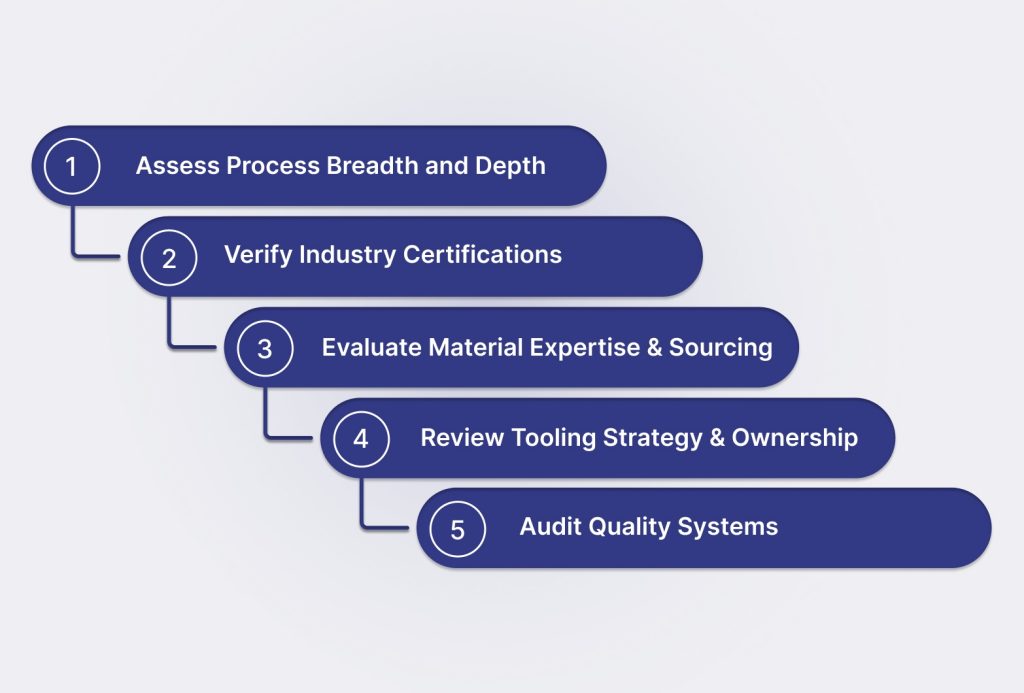
Follow these five criteria to make an informed choice:

  1. Assess Process Breadth and Depth
  • Determine whether your component requires a single process or multiple fabrication steps.
  • A part needing injection moulding, welding, and assembly benefits from a single-source partner.
  • Multi-process capability reduces logistics complexity and qualification effort.
  1. Verify Industry Certifications and Compliance
  • Automotive programs require IATF 16949 and PPAP capability from your supplier.
  • Defence and aerospace demand AS9100 or specific customer approvals.
  • ISO 9001 and ISO 14001 are baseline requirements for quality and environmental management.
  1. Evaluate Material Expertise and Sourcing
  • Confirm the fabricator’s experience with your required engineering polymers.
  • Glass-filled nylons, PBT, Polycarbonate, and ABS+PC require specific processing knowledge.
  • Ask about material sourcing relationships and contingency plans for supply disruptions.
  1. Review Tooling Strategy and Ownership
  • Determine whether the fabricator builds tools in-house or outsources mould development.
  • In-house tooling provides better control over timelines and quality.
  • Understand tool steel selection, expected lifecycle, and maintenance protocols.
  1. Audit Quality Systems and Performance Metrics
  • Request recent audit reports and rejection rate data over 12 months.
  • Verify their process capability (Cpk) monitoring for critical dimensions.
  • Confirm on-time delivery performance exceeds 95% for sustained periods.

A structured evaluation leads you to partners capable of supporting your program lifecycle.

Also read: How to Choose the Right Injection Molding Supplier

Common Mistakes When Choosing a Plastic Fabrication Company

Even experienced procurement teams make preventable errors when selecting a plastic fabrication company under timeline or budget pressure.
These mistakes often surface months later through rework, compliance gaps, or production instability that affects your program’s credibility.

The following mistakes frequently undermine fabrication programs:

  1. Choosing Based on Lowest Quote

Selecting a supplier purely on the lowest quotation often hides labor inefficiencies and higher rejection rates. Lower pricing may reflect limited engineering input, weak inspection controls, or outsourced sub-operations that create coordination delays. 

You may initially save on unit price but incur higher rework, logistics, and escalation costs later.

Solution: Implement a Total Cost of Ownership comparison, including scrap, tooling revisions, logistics exposure, and compliance risk before awarding the contract.

  1. Ignoring Engineering Capability

Overlooking engineering depth increases the probability of dimensional drift and functional failures. Suppliers without DfM support often manufacture exactly what you submit, even when the design needs correction. 

This approach shifts the revision burden back to your internal engineering team and delays program validation.

Solution: Request documented examples of DfM interventions, fixture redesigns, and tooling corrections that prevented downstream issues.

  1. Underestimating Fixture Design Importance

Poor fixture development leads to inconsistent dimensions and weld alignment errors.
Even high-quality materials fail when holding mechanisms during fabrication lack repeatability and inspection validation. 

You may experience variation across batches that complicates assembly integration.

Solution: Audit fixture validation protocols and confirm that dimensional inspection records demonstrate repeatability across production runs.

  1. Overlooking Compliance Documentation

Incomplete traceability and audit documentation create risk exposure during OEM or regulatory reviews. Lack of structured documentation increases audit findings and delays approval for serial production.

This issue becomes critical in automotive, aerospace, and defense programs.

Solution: Review certification scope, traceability documentation, and previous audit outcomes before finalizing supplier onboarding.

Avoiding these mistakes strengthens supplier defensibility during internal leadership reviews and external audits.

If compliance exposure or lifecycle cost volatility remains a concern in your next fabrication program, you should examine how documentation systems align with regulated production environments.

JaiRaj Group applies structured traceability and audit-ready processes across programs such as Precision Components From Advance Polymers and Interior & Exterior Accessories and Components, where validation discipline and certification alignment directly influence approval timelines and long-term program stability.

Industries That Rely on Plastic Fabrication Companies

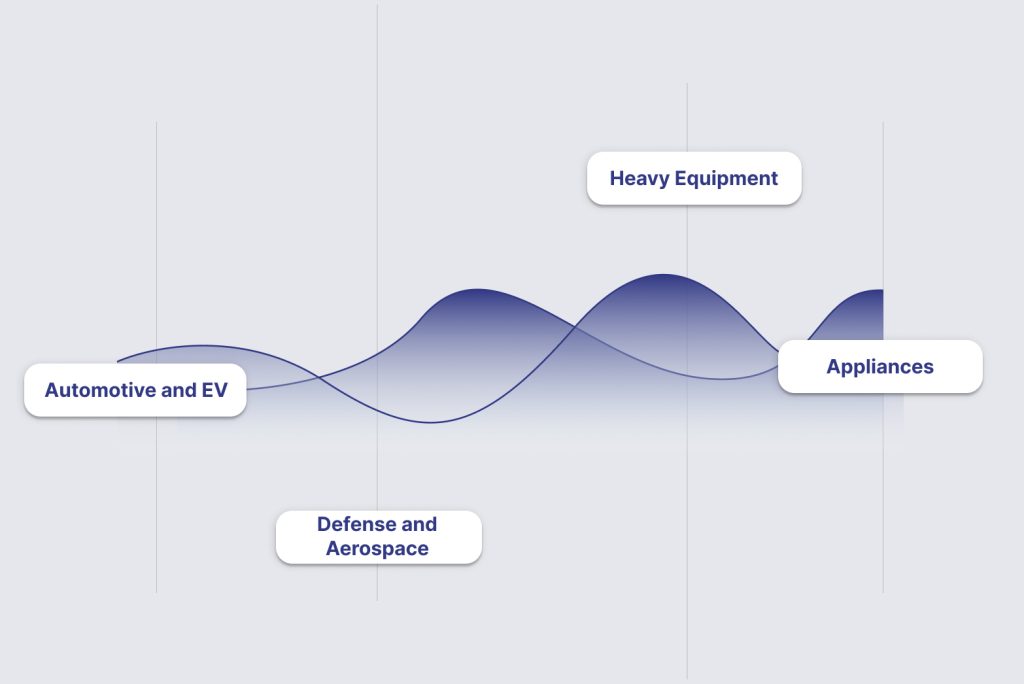
Plastic fabrication companies support sectors that require dimensional precision, material specialization, and scalable production continuity. These industries depend on fabrication partners who understand regulatory expectations, structural performance, and long-term durability requirements.

Industries That Rely on Plastic Fabrication Companies

The following industries depend heavily on reliable fabrication partners:

  1. Automotive and EV

Automotive and electric vehicle manufacturers require fabricated interior panels, brackets, and structural components. Programs demand repeatable tolerances, validated materials, and documentation aligned with OEM quality standards.

  1. Heavy Equipment

Construction and mining equipment manufacturers depend on fabricated enclosures, covers, and protective components. Durability under vibration, temperature variation, and mechanical stress becomes a primary performance requirement.

  1. Appliances

White goods manufacturers require cosmetic panels, trims, and structural housings with aesthetic finish consistency. Dimensional accuracy ensures compatibility with automated assembly lines and consumer-facing quality expectations.

  1. Defense and Aerospace

Defense and aerospace programs require lightweight structural components meeting stringent compliance and traceability standards. Material selection and fabrication precision directly affect certification approvals and long-term reliability.

These industry-specific pressures explain why integrated fabrication capability matters during supplier evaluation.

This context highlights why fabrication depth, compliance discipline, and process integration determine long-term supplier reliability.

How JaiRaj Group Supports Plastic Fabrication and Why You Should Choose Us

You face launch delays, tooling revisions, cost volatility, and compliance exposure when fabrication and moulding suppliers operate separately.

JaiRaj Group provides integrated fabrication, moulding, tooling, welding, and assembly within one coordinated manufacturing structure. Our heavy-duty portfolio includes Roto Moulding Components, Earth Movers and Heavy Vehicle Components.

For mobility and interiors, review Mobility Plastic Base Seating Solutions and Interior & Exterior Accessories and Components.

  • Multi-process fabrication combining injection moulding, blow moulding, rotational moulding, and extrusion.
  • Plastic welding capability is integrated into assembly lines for structural and cosmetic components.
  • Machining and turning support for precision polymer components requiring tight tolerances.
  • In-house tooling and mould development ensure better control over dimensional stability.
  • Automotive, EV, aerospace, and defense sector experience aligned with regulatory expectations.
  • Multi-location facilities supporting capacity resilience and geographic risk distribution.

This integrated model reduces lifecycle risk while strengthening program continuity.

Also read: Effective Quality Control in Injection Molding

Conclusion

Selecting a plastic fabrication company requires evaluating process breadth, certifications, and quality infrastructure. Your decision impacts the total cost of ownership, compliance, and program continuity.

A multi-process partner reduces supply chain complexity and qualification risk. JaiRaj Group applies 35 years of fabrication expertise across diverse industries. We manufacture critical components from solar plastic parts to earth mover panels.

Our integrated model turns complex multi-process requirements into a dependable supply.

Reach out to JaiRaj Group to discuss your requirements.

FAQs

Q. What does a plastic fabrication company do?

A plastic fabrication company shapes polymer materials into finished components. Processes include moulding, machining, welding, forming, and assembly. They produce parts for automotive, defence, aerospace, and industrial applications.

Q. How much does plastic fabrication cost?

Cost depends on part complexity, material, volume, and fabrication method. Tooling for injection moulding is a significant upfront investment amortized over volume. CNC machining has a lower setup cost but a higher per-part expense.

Q. What is the difference between plastic fabrication and injection moulding?

Injection moulding is one specific fabrication process for high-volume parts. Plastic fabrication is a broader term covering moulding, machining, welding, and forming. Fabrication encompasses multiple methods to create finished components.

Q. How do you evaluate a plastic fabrication company?

Assess their process capabilities against your component requirements. Verify certifications like IATF 16949 for automotive or AS9100 for aerospace. Request quality metrics, including scrap rates, Cpk values, and on-time delivery performance.

Q. What materials can be used in plastic fabrication?

Common materials include Nylon (glass-filled), PBT, Polycarbonate, ABS, ABS+PC, Polypropylene, and Polyethylene. Engineering-grade polymers serve automotive, defence, and aerospace applications. Material selection depends on mechanical, thermal, and chemical requirements.

Need Custom Plastic Components?

Get Precision-Engineered Solutions for Automotive, Aerospace, Defence & More.
What do you think?
Leave a Reply

Your email address will not be published. Required fields are marked *

Related news