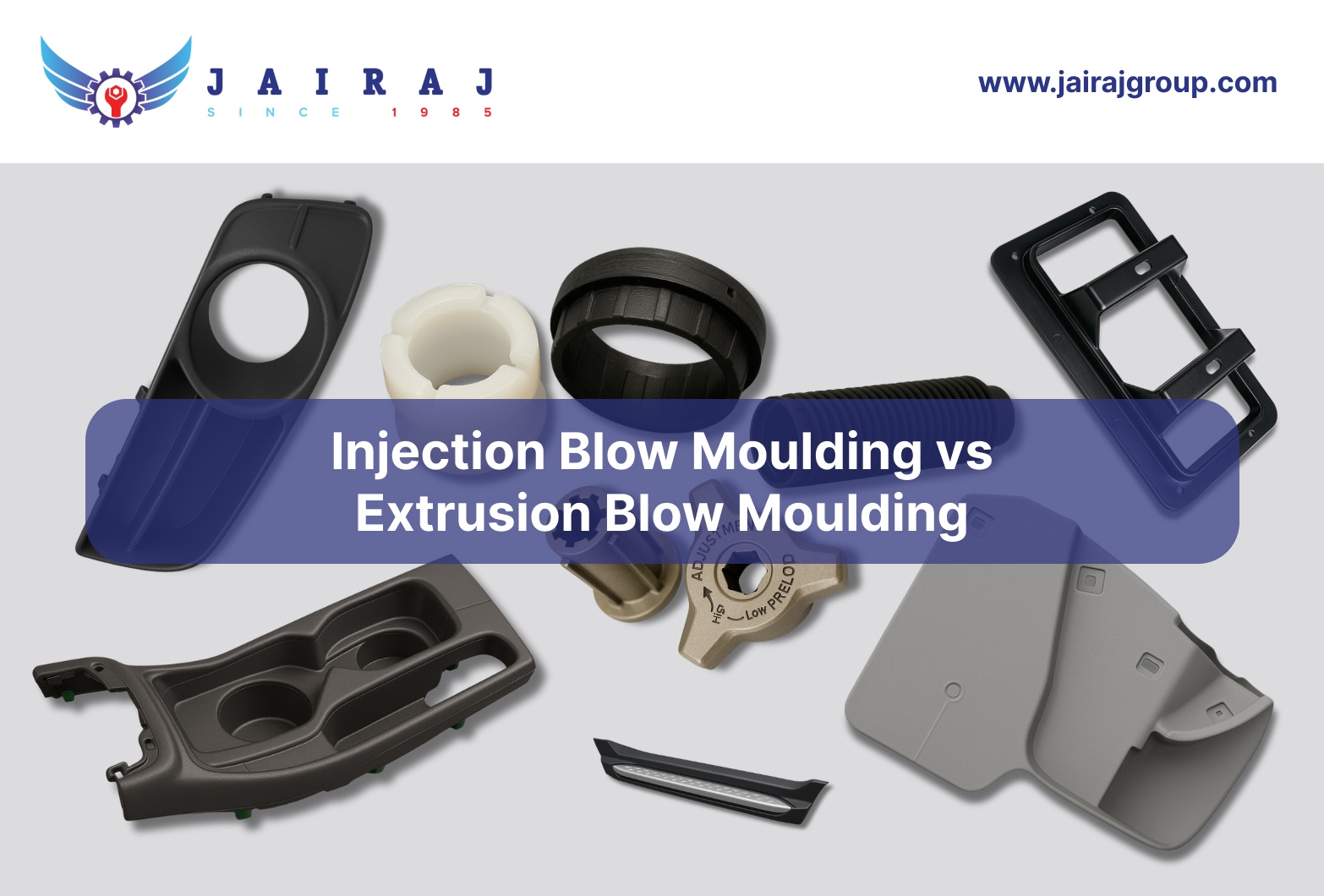
A hollow plastic component fails in the field. The wall is too thin at one end. The neck finish is distorted. The part weighs more than the design specified.
Your supplier selected the wrong blow moulding process. Injection blow moulding and extrusion blow moulding are not interchangeable. Each serves distinct part geometries, volume requirements, and precision tolerances. Choosing incorrectly leads to higher scrap, weaker parts, and delayed timelines.
This guide explains the operational principles of both methods. You will learn the key differences in process, tooling, and application fit. You will also receive a decision framework for your next sourcing program.
Quick Look
- Injection blow moulding produces small, precise, neck-finished bottles and medical vials with zero scrap flash.
- Extrusion blow moulding handles larger, complex shapes with varying wall sections.
- Injection blow requires two-stage tooling and suits high volumes of uniform containers.
- Extrusion blow offers a lower tooling entry cost and flexibility for irregular geometries.
- JaiRaj Group provides both blow moulding and injection moulding solutions across automotive, defence, and industrial sectors.
Key Principles of Injection Blow Moulding and Extrusion Blow Moulding
Both processes create hollow plastic parts. They differ fundamentally in how the preform is created and transferred. Understanding this starting point explains every subsequent trade-off.
The core distinction lies in parison formation and mould movement:
Injection Blow Moulding
Injection blow moulding produces precision hollow parts with a fully finished neck. The process eliminates secondary trimming operations entirely.
- Molten plastic is injection-moulded around a core rod to form a preform.
- This preform has the exact neck finish and threads already fully formed.
- The core rod transfers the preform to a blow mould for final inflation.
- Scrap is nearly zero because there is no flash to trim. Precision is very high.
Extrusion Blow Moulding
Extrusion blow moulding forms hollow parts by inflating a hot tube inside a cooled mould. The process accommodates complex shapes and larger component sizes.
- A continuous screw extrudes a molten tube called a parison downwards.
- The blow mould closes around the parison and pinches it at the top and bottom.
- Air inflates the parison against the mould cavity walls.
- Excess plastic is trimmed as flash and recycled. Part size is highly flexible.
Understanding these mechanisms clarifies why one method suits a medicine bottle and the other suits a Plastic Bellows & Struts component.
When you compare extrusion and injection blow moulding for performance-critical hollow parts, you must assess wall thickness control, flash management, and lifecycle durability.
JaiRaj Group integrates blow moulding with downstream trimming, welding, and validation processes to support applications such as Mobility Plastic Base Seating Solutions, where structural integrity and dimensional stability influence long-term reliability.
Also read: Blow Molding vs Rotational Molding: Key Differences Explained
Differences Between Injection Blow Moulding and Extrusion Blow Moulding
The two processes diverge across seven critical dimensions. Each difference directly impacts your part cost, quality, and program timeline.
Review this comparison table to understand the trade-offs:
| Aspect | Injection Blow Moulding | Extrusion Blow Moulding |
| Preform Formation Method | Preform is injection-moulded around a steel core rod in a separate cavity. The preform is a test-tube-shaped article with the neck finish fully formed. | Parison is extruded as a continuous hollow tube through a die head. The parison hangs vertically under gravity into the open mould. |
| Neck Finish Quality | Neck finish is moulded to its final dimensions during the preform stage. Threads, snap beads, and sealing surfaces are fully formed. No secondary calibration required. | Neck finish is formed by pinching the parison or cutting and calibrating post-moulding. Secondary operations like cutting or spin-trimming are often needed. |
| Wall Thickness Control | Excellent precision with consistent wall distribution. Form design determines final wall thickness. Blow ratio is controlled and predictable. | Good control via parison programming. The gap adjusts during extrusion to vary the wall thickness vertically. Less precise for complex non-round shapes. |
| Part Size Range | Small to medium parts, typically 2ml to 1000ml capacity. Maximum part size is limited by the preform handling mechanics and core rod deflection. | Small to very large parts, from 5ml to 10,000 litres. Suitable for fuel tanks, large ducts, and industrial enclosures. |
| Tooling Cost | High. Requires preform mould, blow mould, and core rod set. Two complete mould halves with precision alignment requirements. | Moderate to low. Single mould with cavity, pinch-offs, and cooling channels. No separate preform tooling required. |
| Tooling Lead Time | Longer, typically 16-24 weeks. Two complete mould systems must be designed, machined, and sampled together. | Shorter, typically 10-16 weeks. Simpler mould construction with fewer moving parts. |
| Part Geometry Complexity | Limited to simple, uniform shapes. Parts should be rotationally symmetrical. Difficult to form handles, offset necks, or irregular contours. | High complexity possible. Can form handles, offset necks, dual-wall components, and irregular shapes. Suitable for automotive ducts and bellows. |
| Material Suitability | Works best with rigid materials: PP, PE, PS, PC. Difficult with heat-sensitive or low-viscosity polymers. | Broad material compatibility: HDPE, LDPE, PP, PVC, ABS, and engineering polymers. Handles a wide melt temperature range. |
| Multi-Layer Capability | Limited. Co-injection blow moulding exists but is complex and costly. Not common for standard production. | Excellent. Multi-layer heads produce co-extruded parisons for barrier layers. Common for fuel tanks and chemical containers. |
| Investment Threshold | High entry cost. Justified only by very high volumes and strict neck tolerance requirements. | Lower entry cost. Suitable for low-to-medium volumes and prototype to production scale-up. |
| Typical Applications | Pharmaceutical bottles, single-dose vials, cosmetic containers, precision medical components. | Automotive reservoirs, Plastic Bellows & Struts, Hand Grips, Mobility Plastic Base Seating Solutions, industrial enclosures, Solar Plastic Components. |
| Secondary Operations | Minimal. Parts are usually complete and ready for filling or assembly upon ejection. | Frequent. Deflashing, neck calibration, leak testing, and post-cooling are often required. |
| Dimensional Repeatability | Excellent for neck finish and critical sealing surfaces. Cpk values of 1.33 or higher are achievable. | Good for body dimensions. Neck finish requires secondary operations to achieve high precision. |
| Weight Consistency | Very high. Preform weight is controlled by injection moulding parameters. Part-to-part variation is minimal. | Moderate. Parison sag and draw-down affect weight consistency over long cycles. |
The decision between these methods is not about superiority. It is about alignment with your specific component requirements.
Also read: Effective Quality Control in Injection Molding
If your component geometry, wall thickness targets, or annual volumes create ambiguity between processes, you should evaluate real production case studies rather than theoretical comparisons.
JaiRaj Group manufactures parts across injection and blow moulding technologies, including Hand Grips and Precision Components From Advance Polymers, where process selection directly influences dimensional control, surface finish, and long-term performance stability.
Which Moulding Process is Right for You to Choose?
Your choice depends on three primary factors: part size, precision requirement, and annual volume.
Choose Injection Blow Moulding When:
- Your component is small, typically under 500 millilitres in capacity.
- The neck finish requires tight dimensional tolerance and zero flash.
- You require a consistent wall thickness across the entire component.
- Annual volumes are high and justify higher tooling investment.
- Applications include pharmaceutical containers, cosmetic vials, and Precision Components From Advance Polymers for medical or defence systems.
Choose Extrusion Blow Moulding When:
- Your component is large, complex, or requires integrated handles.
- Part geometry includes irregular curves, varying diameters, or odd shapes.
- You need lower initial tooling costs for lower-volume programs.
- The application can tolerate flash trimming and material recycling.
- Applications include automotive ducts, Mobility Plastic Base Seating Solutions, Solar Plastic Components enclosures, and Earth Movers and Heavy Vehicle Components.
Consider Hybrid Or Alternative Processes When:
- Your component requires extremely tight tolerances on non-round features.
- You need multi-layer constructions for barrier properties.
- Extremely high volumes of very small precision parts justify injection blow.
- Very large structural parts may be better suited to rotational moulding.
A structured evaluation of these factors prevents process mismatch and downstream costs.
Also read: PP vs PVC: Understanding Performance and Application Differences
How JaiRaj Group Delivers Both Blow Moulding Solutions
Procurement and engineering leaders face a recurring challenge. Their component designs evolve, yet supplier capabilities remain rigid. A vendor offering only extrusion blow moulding will recommend that process even when injection blow is optimal. You need a partner without technology bias.
JaiRaj Group operates dedicated injection blow moulding and extrusion blow moulding production lines. We do not steer you toward a single process. We match the technology to your part requirements.
- Multi-Process Blow Moulding Capability: Our facility runs both injection blow and extrusion blow systems. We manufacture Plastic Bellows & Struts, Hand Grips, and fluid reservoirs across these platforms.
- In-House Tooling and Mould Development: Our tool room designs and maintains preform moulds and blow moulds. This ensures precise neck finishes and optimal parison programming.
- Engineering Polymer Expertise: We process engineering grades including Nylon, Polycarbonate, and ABS+PC. Our components meet the mechanical demands of automotive and defence applications.
- Multi-Industry Compliance: JaiRaj components serve automotive braking systems, aerospace interior ducts, and railway seating assemblies. Our IATF 16949 and ISO certifications validate our quality systems.
- Integrated Assembly and Validation: We perform plastic welding, leak testing, and assembly for complete hollow component solutions.
JaiRaj Group delivers blow-moulded components that meet your dimensional, structural, and volume specifications.
Conclusion
Selecting between injection blow moulding and extrusion blow moulding requires technical clarity. The wrong process yields inconsistent wall thickness, higher scrap, or excessive tooling cost. Correct selection ensures part performance and program profitability.
JaiRaj Group applies 35 years of moulding experience to your component challenges. We produce Shockers & Suspension Components, Roto Moulding Components, and blow-moulded assemblies for leading OEMs. Our multi-process platform delivers what single-technology vendors cannot: objective process selection.
Reach out to JaiRaj Group to discuss your requirements.
FAQs
Q. What is the main difference between injection blow moulding and extrusion blow moulding?
Injection blow moulding uses an injection-moulded preform with a finished neck. Extrusion blow moulding uses a continuously extruded tube called a parison. Injection blow produces flash-free parts; extrusion blow creates scrap flash.
Q. Which process is better for small, precision plastic bottles?
Injection blow moulding is superior for small bottles and vials under 500ml. It provides a fully finished neck and consistent wall thickness. It also eliminates secondary deflashing operations.
Q. Can extrusion blow moulding produce parts with handles?
Yes, extrusion blow moulding is ideal for parts with integral handles. The parison can be manipulated to form handles within the mould. Injection blow moulding cannot produce handled containers.
Q. Is tooling more expensive for injection blow moulding or extrusion blow moulding?
Injection blow moulding tooling is significantly more expensive. It requires a preform mould and a blow mould. Extrusion blow moulding uses a single mould with simpler construction.
Q. What industries commonly use components made from these processes?
Automotive uses ducts, reservoirs, and bellows via extrusion blow. Pharmaceuticals use injection blow for dose cups and vials. Consumer goods, defence, and solar sectors also rely on both methods.