A supplier selection error on a custom plastic injection molding program rarely stays contained. Tooling was delivered weeks late. First articles failing dimensional inspection. Production parts showing sink marks or short shots.
Each issue triggers escalation meetings, containment actions, and recovery plans. Your program timeline compresses. Your team works weekends. Your management asks questions.
These risks are not theoretical. They emerge when supplier evaluation focuses on price per part while ignoring engineering depth, tooling strategy, and quality infrastructure. A low unit quote often conceals higher tooling rework costs, longer cycle times, or frequent dimensional drift. The result is a higher total cost of ownership and constant firefighting.
In this guide, you will learn how to choose a custom plastic injection molding service using measurable criteria, structured evaluation steps, and risk-focused decision frameworks.
Key Takeaways
- Supplier selection dictates your total cost, compliance path, and production start date.
- Evaluate engineering capability before discussing price to avoid design flaws.
- In-house tooling control reduces timeline risk and ensures quality.
- Calculate Total Cost of Ownership (TCO), not just piece price.
- Demand metrics like Cpk, scrap rate, and on-time delivery performance.
- Multi-plant supplier footprints provide critical supply chain resilience.
Why Choosing the Right Injection Molding Service Is a Strategic Decision
Your injection molding partner affects your program’s total cost and timeline. A poor choice risks launch delays and compliance failures. Supplier capability determines production stability over the component’s lifecycle.
Focusing only on unit price ignores tooling and quality costs. EV growth and supply volatility make this choice more critical. Your selection must ensure resilience, not just initial cost savings.
If you are benchmarking suppliers for a safety-critical or cosmetic program, your evaluation must extend beyond machine capacity. JaiRaj Group supports validated injection moulding programs across applications such as Brake & Accelerator Pedal and Interior & Exterior Accessories and Components, where dimensional control, material validation, and compliance documentation directly influence lifecycle performance and audit readiness.
When Do You Actually Need a Custom Plastic Injection Molding Service?
Not every plastic part requires a custom molding service. Understanding the threshold prevents over-engineering and cost escalation. Custom services become necessary when your specifications exceed standard offerings.
Distinguish between standard and custom requirements using these criteria:
Standard vs Custom Injection Molding
- Standard molding uses existing tooling for generic part geometries.
- Custom molding requires new, proprietary tooling designed for your part.
- It involves deep design collaboration and specific material selection.
- Off-the-shelf suppliers fail when you need tight tolerances or advanced polymers.
Signs Your Project Requires Custom Injection Molding
- Your component has complex geometries or critical performance specifications.
- The part is safety-critical, like a Brake & Accelerator Pedal assembly or Shockers & Suspension Components.
- Your design requires multi-material assemblies or overmolding processes for Hand Grips, Interior & Exterior Accessories and Components.
- Regulatory exposure in automotive, defence, or aerospace mandates full traceability for Precision Components from Advance Polymers.
Once you confirm the need for custom services, a structured selection process is essential.
How to Choose a Custom Plastic Injection Molding Service in 7 Steps
Implement this structured evaluation framework for your next supplier selection. Score each potential partner from one to five on each dimension. Weight the dimensions based on your program’s specific risk profile.
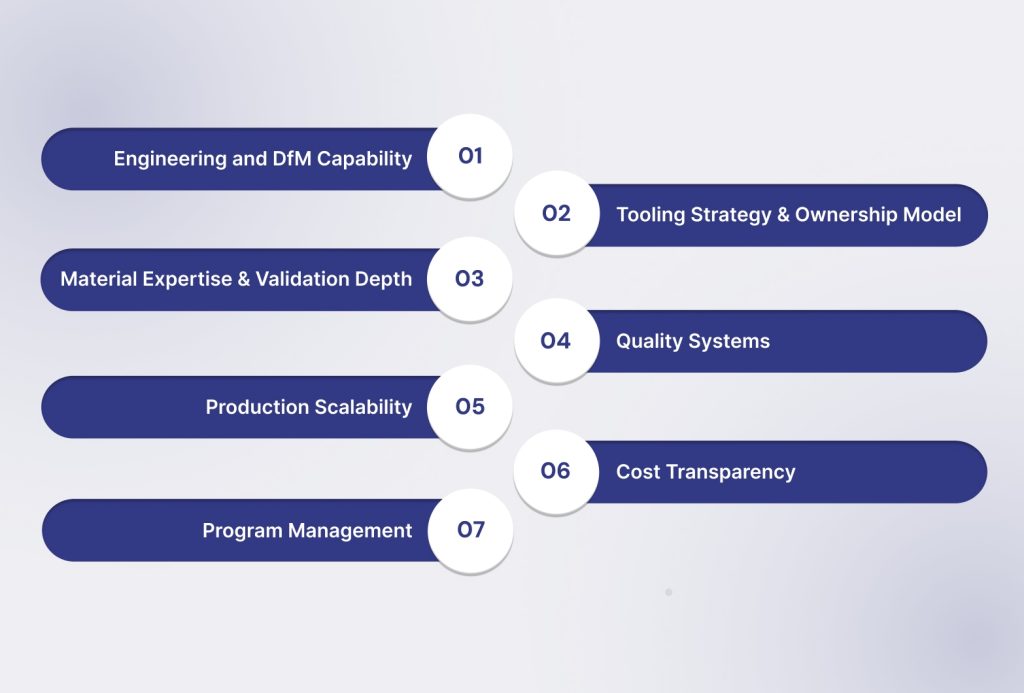
Follow these seven steps to make a confident, defensible decision:
1. Engineering and DfM Capability
A supplier’s engineering input prevents costly manufacturing flaws. They must review your CAD files for manufacturability issues. Look for suggestions on wall thickness, rib design, and gate locations.
- Action: Request sample Design for Manufacturability (DfM) reports.
- Ask: “How many tool revisions did your last three programs require?”
- Verify: Their process to prevent sink marks, warpage, and short shots.
- Outcome: You receive a part design optimized for reliable, low-cost production.
2. Tooling Strategy and Ownership Model
Tooling represents your largest upfront investment and timeline risk. Suppliers with in-house tooling offer better control over quality and schedule. Understand their logic for single versus multi-cavity mold designs.
- Action: Request average tooling lead times for similar complexity parts.
- Ask: “What is your standard tool steel and expected lifecycle?”
- Calculate: Tool amortization cost (Tool cost ÷ lifetime production volume).
- Outcome: You secure a durable tool with a clear maintenance and cost plan.
3. Material Expertise and Validation Depth
The supplier must guide material selection, not just execute your specification. Evaluate their experience with engineering polymers like glass-filled nylons and PBT.
They need robust traceability for regulated industries producing Plastic Bellows & Struts and Braking System Components.
- Action: Review their material datasheet library and compliance certificates.
- Ask: “How do you manage supply disruptions for primary resins?”
- Verify: Their process for material validation and batch testing.
- Outcome: Your component uses the optimal, traceable material for its function.
4. Quality Systems and Compliance Infrastructure
Certifications like IATF 16949 are mandatory for automotive suppliers. The supplier must demonstrate active PPAP and APQP execution. They should monitor process capability (Cpk) for critical dimensions.
- Action: Ask for recent external audit reports and corrective action logs.
- Review: Their scrap and rejection rates over the past twelve months.
- Verify: Their gauge calibration and measurement system analysis practices.
- Outcome: You partner with a supplier that ensures consistent, documented quality.
5. Production Scalability and Capacity Planning
Assess their machine tonnage range and available press capacity. Determine if they have backup machines or shift flexibility.
A multi-location footprint provides crucial supply chain redundancy for high-volume programs producing Earth Movers and Heavy Vehicle Components and Roto Moulding Components.
- Action: Audit their facility map and machine maintenance schedules.
- Ask: “What is your maximum monthly capacity for a similar part?”
- Compare: A single-plant supplier versus one with plants in Sanand and Aurangabad.
- Outcome: You confirm they can scale production to meet your peak demand.
6. Cost Transparency and Total Cost of Ownership
Request a detailed cost breakdown beyond the piece price. Understand how raw material costs, scrap, and cycle time affect the quote. Calculate the Total Cost of Ownership for an accurate comparison.
- Action: Demand a line-item breakdown of their quotation.
- Ask: “How does a 10% scrap rate impact the final unit cost?”
- Formula: TCO = Tooling + (Unit price × volume) + scrap + logistics + risk cost.
- Outcome: You make a sourcing decision based on true lifecycle cost, not just price.
7. Program Management and Communication Discipline
A dedicated program manager ensures smooth execution from trial to production. Evaluate their change management and escalation protocols. Clear communication prevents misunderstandings during critical phases.
- Action: Request to meet the assigned program manager before signing.
- Ask: “What is your standard response time for an engineering change request?”
- Review: Their project management software and milestone tracking methods.
- Outcome: You establish a transparent, responsive partnership for the program’s duration.
This framework requires validation with concrete performance data from suppliers.
If you are assessing long-term program governance, review how suppliers manage complex assemblies such as Braking System Components and Shockers & Suspension Components, where engineering changes, compliance documentation, and cross-functional coordination must remain tightly controlled throughout the product lifecycle.
JaiRaj Group structures its program management around milestone tracking, tooling validation checkpoints, and documented escalation pathways aligned with automotive and industrial OEM expectations.
Also read: Blow Molding vs Rotational Molding: Key Differences Explained
4 Metrics You Should Demand Before Finalizing a Custom Injection Molding Service
Quantifiable metrics separate proven suppliers from potential risks. Demand these performance benchmarks during your final evaluation. They provide objective data on a supplier’s operational maturity.
Insist on reviewing these four critical performance indicators:
Process Capability (Cpk Targets)
- For critical dimensions, expect a Cpk of 1.33 or higher.
- This indicates a stable, capable process with minimal variation.
- Suppliers should provide historical Cpk data for similar components.
- This metric directly correlates with your field quality and rejection rates.
Scrap Rate Benchmarks
- A capable moulder maintains a scrap rate below 2-3% in serial production.
- Calculate it as (Rejected parts ÷ Total parts produced) × 100.
- High scrap rates often signal underlying process or design instability.
- This number significantly impacts your effective cost per part.
Tooling Lead Time Benchmarks
- For a mid-complexity automotive tool, expect 14-18 weeks.
- This includes design, machining, sampling, and approval cycles.
- Suppliers with in-house tool shops often provide more reliable timelines.
- Delays here directly jeopardize your start of production date.
On-Time Delivery Rate
- A reliable partner should have an on-time delivery rate exceeding 95%.
- This metric is critical for your just-in-time or line-side delivery programs.
- Request 12-month performance data to identify seasonal or capacity trends.
- Consistent on-time delivery is a hallmark of mature operational planning.
Ignoring these metrics often leads to predictable sourcing mistakes.
Also read: PP vs PVC: Understanding Performance and Application Differences
Common Mistakes When Choosing a Custom Plastic Injection Molding Service
Procurement teams often repeat these errors during supplier selection. Each mistake increases program cost, risk, or timeline. Recognizing them allows for proactive mitigation.
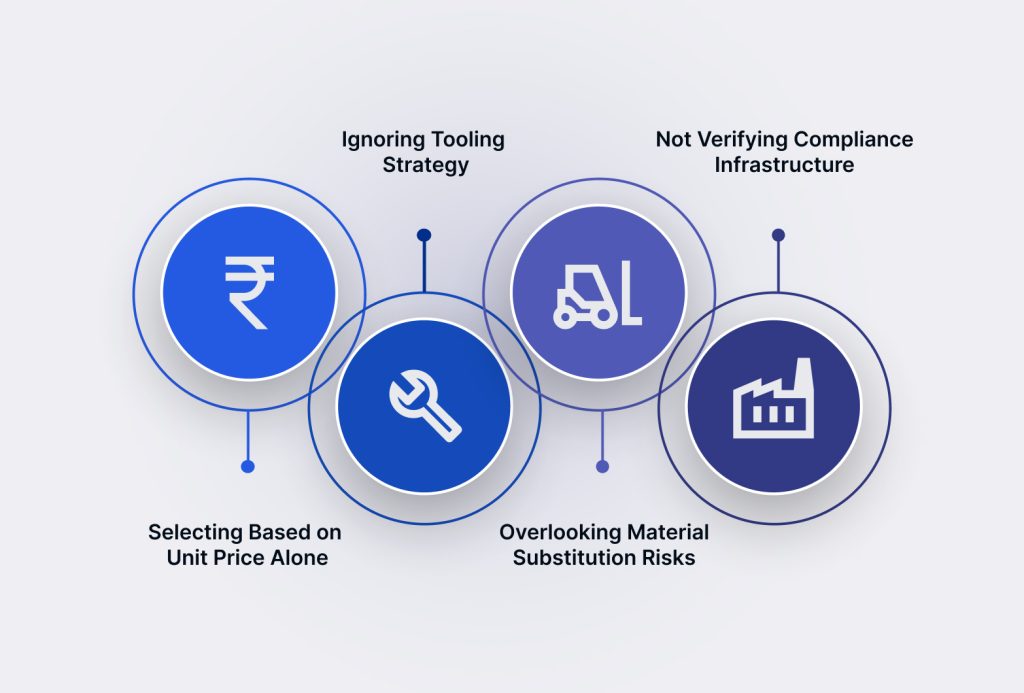
Avoid these four critical mistakes in your evaluation process:
Selecting Based on Unit Price Alone
- Consequence: You incur higher costs from tool rework, scrap, and field failures.
- Example: A cheaper quote may use lower-grade steel, shortening tool life.
- Solution: Use the Total Cost of Ownership (TCO) framework for all comparisons.
Ignoring Tooling Strategy
- Consequence: You face unexpected delays and costs from tool breakdowns.
- Example: An outsourced tool with poor cooling causes long cycle times.
- Solution: Prioritize partners with in-house tooling control and clear maintenance plans.
Overlooking Material Substitution Risks
- Consequence: Component failure occurs due to unvalidated material changes.
- Example: A supplier switches resin grades to cut costs, affecting performance.
- Solution: Mandate strict change control and full material validation protocols.
Not Verifying Compliance Infrastructure
- Consequence: Your audit fails due to supplier documentation gaps.
- Example: Missing PPAP documentation halts your production line.
- Solution: Conduct an on-site audit of their quality management system.
A partner that helps you avoid these pitfalls becomes a strategic asset.
How JaiRaj Group Supports Custom Plastic Injection Molding Programs
OEMs and Tier-1s manage complex launches with high cost and timeline pressure. Inconsistent supplier quality and communication gaps create program risk. You need a partner that integrates engineering with execution.
JaiRaj Group serves as a strategic, full-service injection molding partner. We combine deep technical expertise with multi-plant operational scale. Our approach reduces risk from the initial design phase through volume production.
- Integrated Engineering and In-House Tooling: Our R&D centers handle CAD review, mold flow analysis, and tool building. This ensures precision components are designed for manufacture from the start.
- Advanced Materials and Compliance Expertise: We process engineering polymers like Nylon, PBT, and POM with full traceability. Our IATF 16949 certification supports automotive braking systems and interior components.
- Multi-Industry Application Experience: Our components serve automotive, defence, aerospace, and EV mobility. This cross-industry knowledge informs robust design and validation practices for Mobility Plastic Base Seating Solutions and Solar Plastic Components.
- Scalable, Multi-Location Manufacturing Footprint: Facilities in Manesar, Sanand, and Aurangabad provide capacity and geographic redundancy. This ensures supply continuity for critical programs.
JaiRaj Group delivers reliable custom injection molding for complex, regulated components.
Final Thoughts
Selecting a custom injection molding service requires a strategic, multi-factor evaluation. Your decision must balance technical capability with the total cost of ownership. A rigorous process mitigates risk and ensures long-term supply stability.
JaiRaj Group applies this disciplined approach across diverse manufacturing programs. We produce critical components from solar plastic parts to earth mover panels. Our full-service model turns complex custom projects into dependable supply.
Reach out to JaiRaj Group to discuss your requirements.
FAQs
Q. What questions should I ask a plastic injection molding company?
Ask about their Design for Manufacturability process and tooling strategy. Request their standard scrap rate and process capability (Cpk) data. Inquire about their compliance certifications and material traceability systems.
Q. How much does custom injection molding cost?
Cost depends on part size, complexity, material, and annual volume. The largest cost driver is the custom tool, amortized over the part’s lifetime. Always analyze the Total Cost of Ownership, not just the piece price.
Q. What certifications should an injection molding supplier have?
For automotive, IATF 16949 is essential. ISO 9001 and ISO 14001 are baseline quality standards. Suppliers serving defence or aerospace may require AS9100 or specific customer approvals.
Q. How long does custom injection tooling take?
Tooling lead time typically ranges from 14 to 20 weeks for a complex mold. This includes design, machining, sampling, and approval stages. In-house tooling capability often provides better schedule control.
Q. What is the difference between OEM and custom injection molding?
OEM molding often follows very specific, customer-owned designs and standards. Custom molding involves collaborative design and development from concept. Both require high precision, but custom services demand greater engineering partnership.