
Introduction
Pop the hood on a modified truck or a track-day build, and you'll likely spot a shiny stainless braid wrapped around the radiator hoses. It looks tough, reads as "performance," and often costs more than a plain black hose. But a metallic sleeve alone doesn't guarantee better cooling, higher pressure tolerance, or a longer service life.
Many shops and DIY builders assume braid equals strength. In reality, the braid usually sits outside the coolant-carrying hose, protecting it from abrasion rather than reinforcing it against heat or pressure.
What matters is whether the braid solves an actual problem, like chafing near a fan shroud or exposure in a tightly packaged engine bay.
This guide breaks down what these hoses are actually made of, when the stainless layer earns its keep, and how to choose and install one without hiding a bigger problem underneath.
Key Takeaways
- Inner rubber, silicone, or polymer tube carries coolant; the stainless braid mainly protects it.
- Expect abrasion resistance and tight-bay protection, not automatic temperature or pressure gains.
- Spec by ID/OD, working pressure, burst pressure, and coolant compatibility, not appearance.
- Inspect by hand: braid can hide cracks, bulging, or seepage.
Understanding Braided Stainless Radiator Hoses
What's Actually Inside the Braid
Three distinct products get sold under this name:
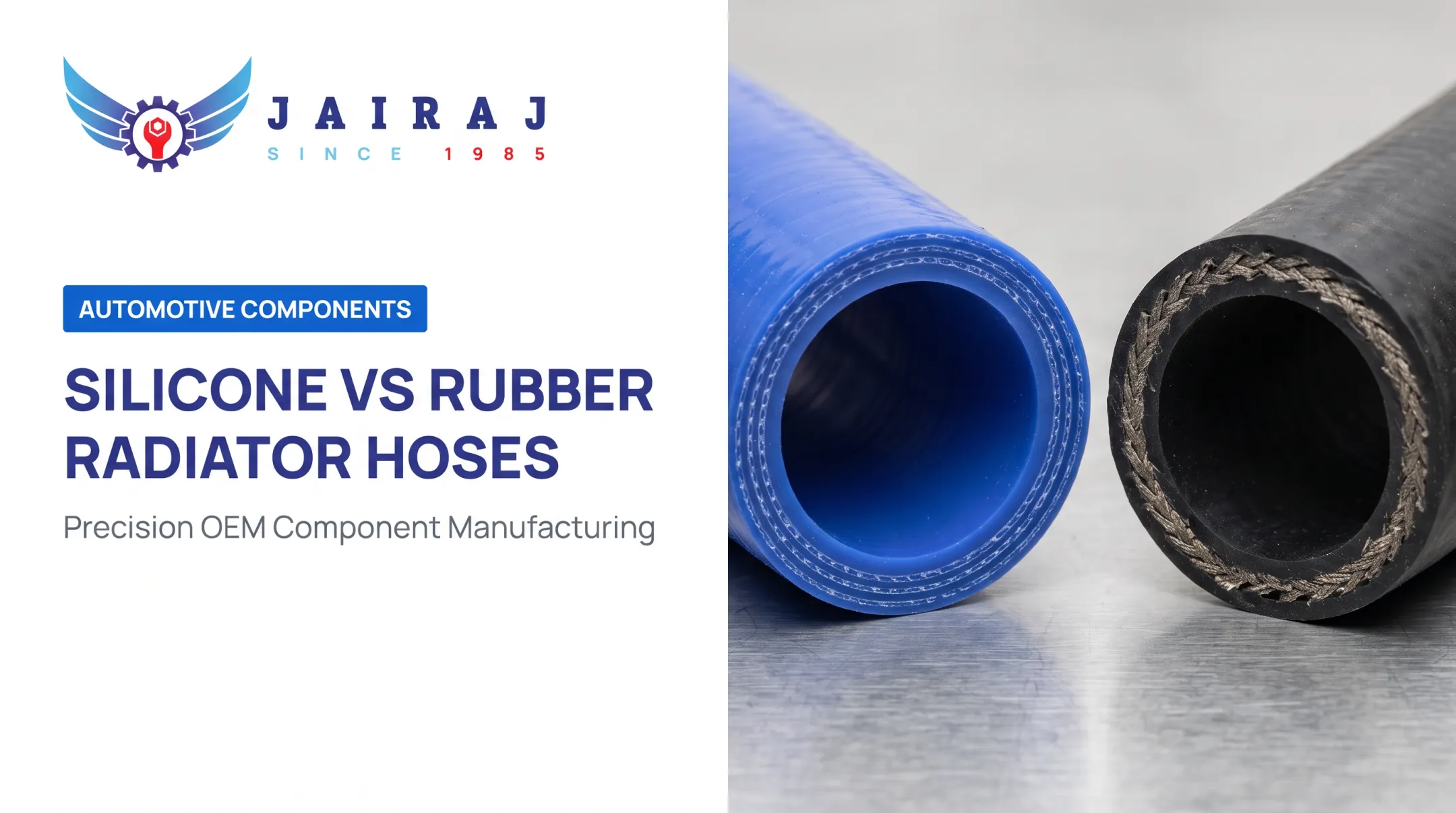
- A conventional rubber or silicone radiator hose wrapped in a stainless-steel sleeve for external protection
- A hose with an internal reinforcement layer, such as fabric plies or wire, that also happens to wear a stainless cover
- A complete assembly with bonded or crimped end fittings, built as a single engineered unit
One documented example: Spectre's 58221 kit uses a corrugated nitrile-rubber hose reinforced with 304-grade stainless braid, finished with aluminum Magna-Clamp fittings. The rubber (not the stainless layer) carries the coolant and absorbs the heat cycling.
How Each Layer Earns Its Place
Picture the hose in cross-section, working from the inside out:
- Inner tube: carries the coolant and absorbs heat, pressure, and vibration cycles
- Reinforcement layer: fabric plies or wire that establish the hose's working and burst pressure rating
- Stainless braid or sleeve: guards against external abrasion and rubbing; it isn't the pressure-bearing layer
- End fittings and clamps: crimped, bonded, or clamped terminations that are frequently the actual failure point
The Hose's Job in the Cooling System
Upper and lower radiator hoses move coolant between the engine, radiator, thermostat housing, and water pump. They flex to absorb engine movement and thermal expansion while keeping a sealed path for coolant under pressure. A hose that's too stiff fights that movement; one that's too soft can collapse under vacuum on the return side.
Key terms worth knowing: hose assembly, braided sleeve, reinforcement layer, coolant compatibility, working pressure, burst pressure, bend radius, ID (inside diameter), and OD (outside diameter).
Don't assume "stainless steel braided" on a label means a higher temperature or pressure rating. SAE's J20 standard covers reinforced and flexible hoses for water- and ethylene-glycol coolant systems, but compliance with that standard alone doesn't tell you the rating of a specific braided assembly. Always check the manufacturer's documentation for the complete hose, not just the braid material.

Benefits and Limitations of Braided Stainless Radiator Hoses
Where the Braid Actually Helps
Stainless braid earns its cost in specific situations:
- Protecting hoses from rubbing against brackets, fan shrouds, pulleys, or bodywork in modified or tightly packaged engine bays
- Adding external reinforcement where custom routing puts a hose closer to moving or hot components than a stock layout
- Resisting cuts from sharp edges in off-road or heavy-equipment applications
What it can't fix: an undersized inner hose, poor routing, a cracked fitting, or a loose clamp. Braid wrapped around a bad hose is still a bad hose.
Braided vs. OEM-Style Hoses
| Factor | OEM-style (rubber/silicone) | Braided stainless |
|---|---|---|
| Visual inspection | Easy: cracks and bulges are visible | Harder: braid can hide damage |
| Abrasion resistance | Lower | Higher |
| Fit | Factory-matched | Often needs custom routing |
| Best for | Stock vehicles, routine inspection | Verified abrasion or routing risk |
Stock vehicles usually do better with a quality OEM-style hose you can actually see. Braided assemblies make more sense when abrasion, vibration, or custom routing creates a documented need.
The Real Risks
- Hidden deterioration: a sleeve can conceal bulging, cracking, staining, or seepage in the hose underneath
- Loose or frayed braid: can chafe wiring, paint, or neighboring hoses instead of protecting anything
- End-fitting failure: bunched braid, incompatible clamps, or over-tightening often cause leaks at the ends rather than along the hose body
Gates notes that electrochemical degradation weakens coolant hose from the inside and is not obvious from a visual check. Its troubleshooting guide recommends squeezing the hose ends and comparing their softness to the middle section.
Inspection Discipline Matters More, Not Less
Because braid limits visibility, inspect more deliberately:
- Street and track vehicles: check at every service interval, squeezing hose ends by hand
- Off-road and heavy equipment: inspect after exposure to abrasive terrain or debris
- Fleet vehicles: follow the manufacturer's documented replacement guidance rather than a generic interval
Decision rule: use braid when it addresses a verified abrasion, routing, or packaging problem. If the motivation is styling alone, a quality standard hose, a protective sleeve, or simple rerouting usually serves better.
Safety note: any overheating, coolant loss, steam, unusual smell, or a rapidly climbing temperature gauge means stopping the vehicle safely and diagnosing the cooling system before continuing to drive.
How to Choose the Right Braided Stainless Radiator Hose
Start With Your Application
Before comparing products, nail down:
- Vehicle, engine, and coolant type in use
- Operating environment: street, track, off-road, commercial, or industrial
- Whether the job is an OEM replacement, a modified build, or new fabrication
- Confirmation that the hose is rated for coolant service, not fuel, oil, or hydraulic fluid
Measure Correctly
Inside diameter (ID) generally drives fitment against the mating neck; outside diameter (OD) matters for clamp selection and clearance.
- Measure your existing hose and connection points directly
- Cross-check against the manufacturer's dimensional chart
- Confirm whether published dimensions refer to the bare hose or the finished braided assembly
- Check installed length, clocking, bend radius, and clearance at full engine movement before ordering
Check Thermal and Pressure Ratings
Ratings vary significantly by construction. For example, Gates' 2022 catalog lists its Green Stripe EPDM coolant hose at 257°F continuous and 302°F peak, with a 68 psi maximum working pressure at 1-1/4-inch ID. Its Durion silicone hose rates considerably higher with aramid reinforcement.
These numbers describe specific named products, not braided assemblies in general. The complete hose assembly's rating (not the stainless braid alone) has to meet your vehicle's operating requirements. Reference your vehicle manufacturer's documented coolant and pressure specs instead of assuming a figure.

Confirm Coolant Compatibility
- Check resistance to your specific coolant formulation (ethylene glycol, propylene glycol, or glycerin-based)
- Verify compatibility with additives and contaminants likely in service
- Don't assume EPDM and silicone perform identically; confirm with manufacturer data for each product
Evaluate Construction Quality
Look past "race" or "heavy-duty" labels and check:
- Braid material, grade, and coverage percentage
- Outer coating or protective sleeve condition
- Liner quality and fitting material
- Crimping or bonding method at terminations
- Available dimensional tolerances, inspection documentation, and warranty terms
Sourcing Custom or OEM Hose Assemblies
For OEM and industrial buyers evaluating a custom automotive polymer component or hose-related assembly, manufacturing depth matters more than marketing language. Jairaj Group works across injection molding, extrusion, and precision polymer engineering, backed by in-house tooling, PLC-controlled machinery, and documented testing under ISO 9001:2015.
If you're specifying a custom component, bring drawings, material requirements, volumes, and validation criteria to the conversation. Don't expect a stock braided hose off a shelf.
Installation and Maintenance Best Practices
Before You Start
- Work only once the engine and coolant system are fully cool
- Follow your vehicle's procedure for draining or depressurizing the coolant
- Wear appropriate protection: coolant is toxic and can stay hot even after the engine stops running
- Remove the old hose carefully to avoid damaging radiator necks, thermostat housings, or sensors
Fitting and Clamping
Test-fit the new assembly before final installation. Confirm orientation, bend radius, and that the braid clears belts, fans, exhaust components, and wiring.

- Use clamps rated for the specific hose construction; a standard worm-drive clamp isn't automatically right for every braided assembly
- Keep braid ends from fraying or bunching at terminations
- Follow the supplier's torque, lubrication, and termination instructions rather than guessing a generic number
- Avoid over-tightening, which can distort the sealing surface or damage the inner hose
After Installation
- Refill and bleed the cooling system per the vehicle's procedure
- Inspect for leaks and verify the system reaches and holds normal operating temperature
- Run a pressure test where the vehicle or hose manufacturer specifies one
- Recheck clamp areas, braid movement, and nearby components for abrasion after the first drive and at every scheduled service
Warning signs that call for replacement or professional diagnosis:
- Visible braid damage or exposed inner hose
- Persistent seepage or coolant staining
- Unexplained overheating
Frequently Asked Questions
Are braided radiator hoses better?
They can outperform a standard hose where abrasion, routing, or reinforcement is a verified issue, but they aren't automatically better than a correctly specified OEM-style hose.
Should radiator hoses be hard or soft?
A hose should flex enough for its designed movement and bend radius without feeling spongy, collapsed, or abnormally hard. Either extreme usually signals deterioration.
Are flexible radiator hoses any good?
Flexibility helps when temperature, pressure, coolant compatibility, and bend-radius ratings all match the application. Flexibility alone doesn't indicate quality.
What does a radiator hose do in a car?
Radiator hoses circulate coolant between the engine, radiator, thermostat housing, and water pump, transferring heat away from the engine block.
What is the temperature rating for stainless steel braided hoses?
Ratings depend on the inner material, reinforcement, and fittings of the complete assembly. Check the manufacturer's continuous and intermittent temperature specifications rather than assuming a universal figure.
Is radiator hose measured ID or OD?
Fitment is generally based on inside diameter and connection size, while outside diameter matters for clamp selection, clearance, and confirming the full braided assembly's dimensions.